I'm Rachael
Mom of 3 & Baby Sleep Expert with Big Sis Energy
& I’VE DONE ALL THE RESEARCH FOR YOU ALREADY.

Better sleep for the entire family

hey!
Safe Bed Sharing Guidelines: How to Co-Sleep More Safely With Your Baby
May 8, 2026
In this article:
- what is bed sharing?
- safer bed sharing guidelines
- when to avoid bed sharing
- what about “chest sleeping?”
- ready to move on from bed sharing?
- frequently asked questions
When I first became I parent I never thought I would bed share with my baby. I thought it was something only hippie “attachment parents” did and it never even entered my mind as a possibility. But I was exhausted, and so I’d fall asleep with my baby while sitting up in bed and breastfeeding him. Or I’d sleep with him on the recliner. I didn’t know these things were so much less safe than intentional bed sharing following the safety guidelines.
What is Bed Sharing?
Bed sharing is sharing a sleep surface with your baby or child. It’s often called “co-sleeping” which is actually the umbrella term for sleeping in proximity to your child. Bed sharing is co-sleeping, but co-sleeping isn’t necessarily bed sharing. Co-sleeping can be done with the infant in their own sleep space in the parents’ bedroom, like a crib or bassinet.
However, most parents will bed-share at some point, even if they never planned to, so it’s important to understand the risks and how to set up a space that will be as safe as possible.
Safer Bed Sharing Guidelines
Currently in the U.S., the official recommendation from the AAP states: “Although the AAP cannot recommend bed-sharing based on the evidence, it also respects that many parents choose to bed-share routinely for a variety of reasons. It is recommended that infants sleep in the parents’ room, close to the parents’ bed, but on a separate surface designed for infants, ideally for at least the first 6 months.”
This type of statement which acknowledges bed sharing may happen but doesn’t give detailed information on risk mitigation can be confusing for parents. Especially because bed sharing in the absence of known hazards is just as safe as any other sleep arrangement when it comes to SIDS risk. There is no significantly increased risk for SIDS associated with bed-sharing in the absence of sofa-sharing, alcohol consumption and smoking. These are the things the AAP should be focused on raising awareness about, much like the “back to sleep” campaign. Luckily there are multiple good sources that provide information on how to set up a safe space for sleeping with your baby should you choose to or need to.
Recently the NHS, the publicly funded healthcare systems in the United Kingdom, updated their guidelines for safe sleep to include messaging about what to do if you end up bed sharing with your baby. Also out of the U.K is BASIS (Baby Sleep Information Source), an evidence-based website providing research on biologically normal infant sleep and safe sleeping practices developed by Durham University in partnership with UNICEF. The Lullaby Trust is a UK-based charity dedicated to preventing sudden infant death syndrome (SIDS) and supporting bereaved families.
A similar organization out of Australia called Red Nose is a leading charity dedicated to saving the lives of babies and children during pregnancy, infancy, and early childhood. They provide evidence-based safe sleep guidance.
You may have also heard of the “Safe Sleep Seven” guidelines which were put forth by La Leche League, non-profit organization founded in 1956 that provides mother-to-mother support, education, and encouragement to parents in their feeding journeys. These guidelines are frequently cited in the U.S.
I’ve compiled these sources to provide the following evidence-based guidelines for how to safely sleep with your baby.
Baby always sleeps:
- On their back, not side or tummy.
- On a firm, flat surface (meets current safety standards, not propped or inclined).
- Head and face must be uncovered: No loose bedding, pillows, duvets, or soft toys near the baby’s face.
- Keep adult bedding at your waist level; use your clothing/blanket, not baby’s, for your warmth.
Sleep environment:
- No cords, necklaces, pacifier chains, or long hair near baby’s face/neck—tie hair back and remove jewellery.
- Baby is lightly dressed; avoid overheating (room comfortably cool, no hat indoors, no heavy layers). Baby should never be swaddled, but a sleep sack may be used for warmth if needed. To be sure baby isn’t too hot, monitor to be sure they aren’t flushed, red or sweating.
Mattress and bed:
- Firm, flat mattress (not sagging; no memory‑foam, feather toppers or soft underlays like lambswool).
- Move the bed away from walls and gaps; ensure baby cannot get wedged between mattress and wall/bed frame. If there is a gap between the mattress and a piece of furniture like a nightstand or between the mattress and headboard, pack it tightly with a rolled sheet to create a flush surface.
- Consider mattress on the floor if there is any risk of rolling; ensure no hazards on the floor nearby (including piles of pillows)
- The ideal set up is a firm mattress, in the middle of the room very low or on the floor with just a pillow for the parents head and a light blanket around their waist.
Baby’s position:
- Place baby on their back beside one parent (ideally the breastfeeding mother), away from the edge; never between two adults or next to siblings or pets. After one year baby can be placed between two sober, aware parents if necessary.
- Create a clear sleep space next to you (e.g., keep blanket tucked at your waist, keep pillows away from baby’s head).
Adult positioning:
- Mother should take the “cuddle curl” posture in breastfeeding bed‑sharing, which evidence suggests is protective.
- Lie on your side, with your body curled around the baby in a “C‑shape,” baby’s head at breast level, your lower arm above baby’s head and knees drawn up below baby’s feet.
- This position tends to prevent you from rolling forward over the baby and keeps blankets low.
Breastfeeding context:
- Breastfeeding pairs tend to stay in safer positions during the night. Breastfed babies rarely sleep in a dangerous prone (stomach) position when sharing a bed; they tend to stay on their backs or side-lie to feed. The baby is also more likely to stay near the breast, whereas formula fed babies who bed share are more often found up near the parent’s face or parent’s pillows, which is not as safe.
- Both mother and baby are more easily aroused when in close proximity, preventing deep, unresponsive sleep that can be dangerous. Professor James Mckenna states that “breastsleeping” is associated with “in increase in brief awakening periods and breastmilk consumption, effects that enhance protection against sleep related deaths”
Risk‑reduction if you expect to fall asleep with baby:
- Plan for reality: We know that breastfeeding makes us drowsy naturally, thanks to hormones. If you feed in bed at night and might fall asleep, prepare the bed as if you will bed‑share, rather than feeding with baby on a sofa or recliner. You may want to learn the side-lying position for breastfeeding or set up in the middle of the bed to avoid your baby slipping in your arms to the floor should you doze off while feeding.
- Never bring your baby to bed if your partner is unaware that they’re there, or if they take any medications/ drugs or drink alcohol. If you bring the baby to bed and may fall asleep, wake your partner to let them know the baby is now in the bed. An aware, committed, sober caregiver(s) who can easily rouse and respond to an infant’s distress is a nonnegotiable for bed sharing.
- Do not allow other children or pets in the bed as this can be a hazard for things like overlaying. Young children can’t be as aware of the risks as we are. If you must have more than one child co-sleeping with you, consider a small cot or floor mattress beside the bed for your older child and set up safely for your infant. Or, have your older child on the outside of the bed beside your partner, and the baby on the outside of the other side of the bed, with you in the cuddle curl around them. Another solution would be a side-car crib for your baby to be close by but safe in their own space, with your toddler or older child on the other side of you, with you in between.
When to Avoid Bed Sharing
As I’ve mentioned previously, bed sharing isn’t for everyone. While it’s important to understand the safety guidelines should bed sharing happen unintentionally, there are situations where it’s not recommended:
- If you’re exhausted, sick, or on medications that may cause drowsiness or reduce your ability to be alert, or if you are taking any other drugs (such as marijuana), if you smoke, or if you’ve consumed alcohol. Blabey and Gessner (2009) examined 13 years of data on Alaskan infant deaths while bed-sharing. In 99% of cases at least one additional risk factor was present. The most common of these was maternal tobacco use (75%), followed by sleeping with an impaired person (43%). Blair et al (2009) in the UK found that 25% of babies who died while co-sleeping were doing so with an adult who had consumed 2 or more units of alcohol, and in a subsequent paper Blair’s team found that sleeping with a baby on a sofa or after drinking 2 or more units of alcohol were both associated with a very high risk.
- If your baby is premature or medically fragile. As discussed in the SIDS section, the Triple Risk Model states that babies who are premature, were low birth weight, or have other medical fragilities (especially breathing or heart related) are especially vulnerable.
- If your bed(room) cannot be set up safely. If you have a soft mattress or one made of memory foam, it is especially unsafe for an infant. Adult mattresses in general are not technically approved for infant sleep because they don’t go through the same safety test that infant crib mattresses do. So if your baby will be sharing your adult mattress, it needs to be very firm. Professor James Mckenna also notes that obesity can be a risk, as the mattress may dip and create an unsafe/ unstable surface for an infant. If your room is set up in such a way that your bed is high off the ground or up against a wall, the risk of your baby falling or becoming entrapped is too great. If you have other children or pets in your bed, your infant should remain in their own sleep space.
- If you can’t monitor your baby. Never leave an infant unattended on an adult bed. If you can’t stay with your baby, they should be put to sleep in an infant-approved sleep space (bassinet, crib, pack’n’play etc).
[Safety Tip: Be sure that anyone caring for your baby (parents or in-laws, a nanny etc) is aware of all of these safety guidelines and can agree to them.]
What About “Chest Sleeping?”
The chest-to-chest position feels incredibly instinctual, especially in early postpartum. Babies love it too, with the benefits being very well documented in research on “kangaroo care” or chest-to-chest, skin to skin contact. Kangaroo care is an evidence-based practice where a diapered infant is placed on a parent’s bare chest, and is shown to significantly improve outcomes for premature and low-birthweight babies by stabilizing heart rate, improves oxygen saturation, and regulating temperature. However, kangaroo care is studied in a very different context than the home.
Current safety guidance does not advocate for chest-to-chest position for baby sleep unless you’ll be awake for a few reasons. One, there is a risk that baby will fall, slip or slide off of your body while you’re asleep, putting them in an unsafe position. They may fall off the bed, or become wedged or trapped between your body and pillows. There’s also the issue of positioning. We know that the safest position for babies to sleep in is on their backs. If they are placed on a parent’s chest for sleep and the parent is elevated too much or too little, baby’s airway could become kinked, compromising their breathing.
If you’re taking shifts with your partner, be sure they can monitor you and your baby while you sleep this way to be sure they stay in a safe position. However, if you’re going to be sleeping too (or if there is a chance you’ll fall asleep during breastfeeding, for example), and there is no other way for you and your baby to get sleep, it’s important to reduce as many of the hazards as possible when it comes to chest sleeping. There are also those nights when your baby is sick or uncomfortable where they simply will not settle anywhere but on your chest. In situations like these, parents just have to do their best. This is why it’s important to know how to best mitigate the risks:
- Rather than lying down flat as you normally would, keep yourself and your baby slightly elevated, ensuring your baby’s head is higher than their bum, rather than a prone belly-down position.
- Dress your baby and yourself lightly, so they don’t overheat
- Your mattress should be on the ground or as low as possible. You can prop yourself up with firm pillows in the center of your firm, clear mattress.This way if baby does accidentally roll, they won’t fall onto the floor. Make sure any pillows are behind your body, so they won’t pose a suffocation risk for your baby should they slip off your body.
- Place baby’s cheek on your chest, near your heart. Place your hand onto their bum or lower back as you sleep, to ensure they don’t slip off.
- Use only thin, breathable sheet or light blanket over your legs if needed. Keep the area above your waist clear of anything soft or fluffy like duvets or pillows, in case your baby slips down while you’re sleeping.
- Periodically try to get your baby used to sleeping next to you rather than on you by setting up your bed for safe bed sharing and/or try to feed them to sleep in the side-lying position on your firm, clear mattress.
Ready to Move on from Bed Sharing?
Bed sharing works well for some families long term, while others eventually feel ready for more space or different sleep arrangements. Both are okay.
If bed sharing is no longer working for your family, transitions can still be gradual, responsive, and supportive.
For babies and younger toddlers (roughly 0–18 months), our Crib & Floor Bed Guide offers gentle strategies for helping your child sleep in their own space.
For older toddlers and children (18+ months), our Moving On From Co-Sleeping Guide provides responsive approaches for transitioning away from bed sharing without traditional sleep training methods.
Frequently Asked Questions About Bed Sharing
Is bed sharing the same as co-sleeping?
No. Co-sleeping is the umbrella term for sleeping near your baby. Bed sharing is one form of co-sleeping where parent and baby share the same sleep surface.
Is bed sharing safe?
There is no completely risk-free infant sleep arrangement. Research suggests that many of the increased risks associated with bed sharing involve additional hazards such as smoking, alcohol use, unsafe sleep surfaces, overheating, or sofa-sharing.
Is sleeping with my baby on a couch or recliner safe?
No. Sleeping with a baby on a couch, recliner, or armchair significantly increases the risk of suffocation and entrapment.
What is the cuddle curl position?
The cuddle curl is a side-lying sleep position commonly used during breastfeeding bed sharing. The parent curls their body around the baby in a protective “C-shape” with knees bent and arm above baby’s head.
Can formula-fed babies bed share?
Some formula-feeding families do bed share. However, research suggests breastfeeding parents and babies may naturally adopt safer nighttime positioning patterns during bed sharing.
Can my baby sleep between two adults?
Infants under one year old should not sleep between two adults.
Can I bed share if I smoke?
No. Smoking significantly increases the risk of sleep-related infant death.
Can I bed share if I drank alcohol?
No. Alcohol and substances that impair awareness make bed sharing unsafe.
Can premature babies safely bed share?
Bed sharing is not recommended for premature babies, medically fragile infants, or babies with low birth weight.
Is a floor bed safer for bed sharing?
Some families choose floor beds to reduce fall risks. A safer floor bed setup still requires a firm mattress, minimal bedding, and a hazard-free surrounding space.
How do I transition away from bed sharing?
Transitions away from bed sharing can happen gradually and responsively. Many families begin by introducing a floor bed, sidecar crib, or independent sleep space while continuing to offer connection and support.
binge reads
We think you'll love these
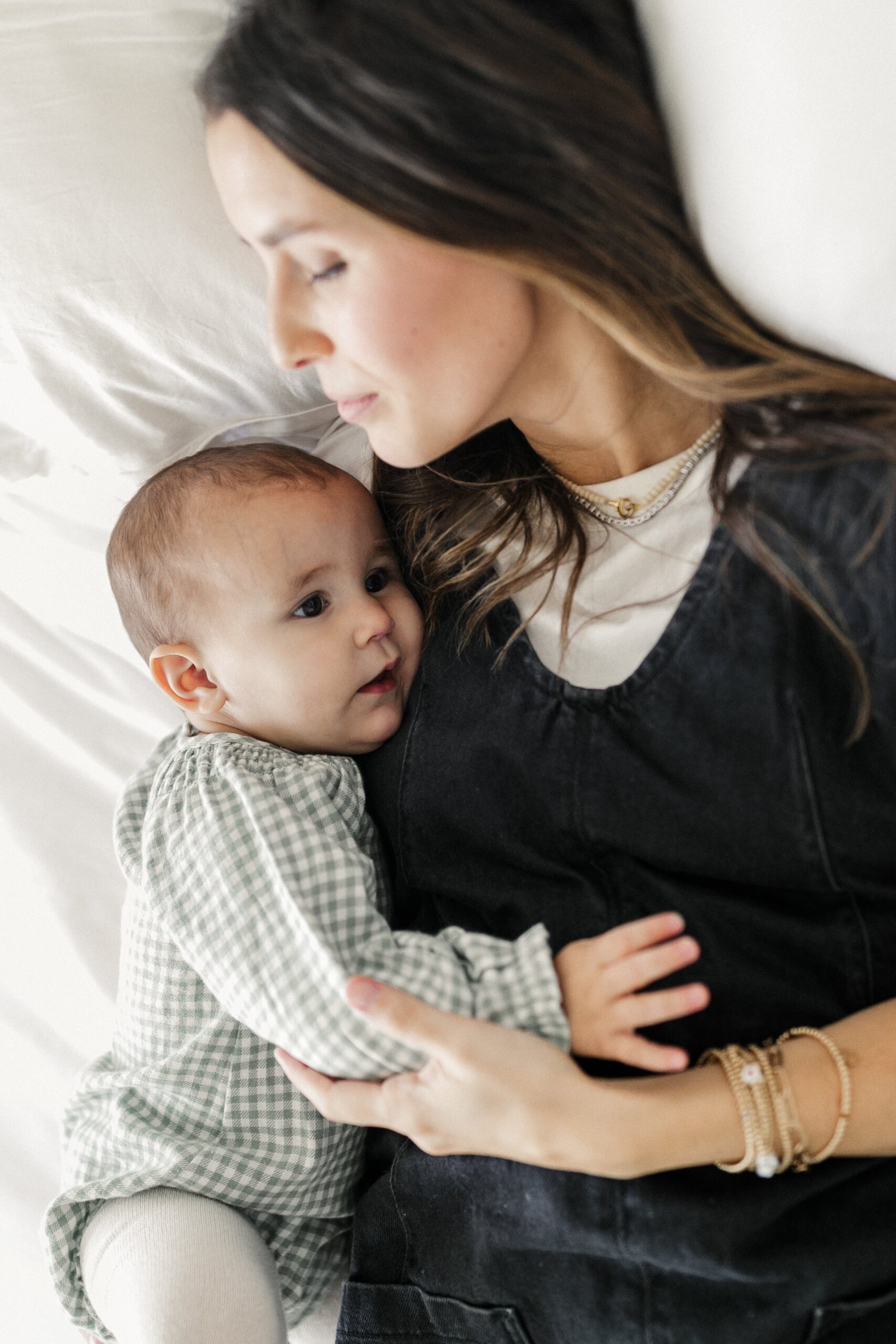


Hey, I’m Rachael — and I want to show you an way to get your babies and bigger kids to
I started Hey, Sleepy Baby for parents who want their nights back... without forceful sleep training or guilt. I’ve already done the research (trust me), diving deep into infant sleep biology, attachment, and conscious parenting.
With a Master's in Education, certifications in infant-parent mental health, and extensive training in responsive sleep strategies, I help parents untangle what really matters: gentle, real-life methods that honor your baby's cues and your sanity.
When I'm not writing or coaching, I'm chasing little humans, over-analyzing coffee strength, or reminding myself that tomorrow is a fresh start. I'm rooted in research but here for real life.


easier
sleep well.
MEET YOUR SLEEP CONSULTANT
You deserve to the
baby stage, not just "survive it."
And you DON'T have to sacrifice your values, ignore your instincts, or force yourself to follow a method you don't align with just to get your baby back to sleep.
I’m here to help you create a restful, sustainable sleep environment that honors both your baby’s needs AND your own (without the stress OR the guilt!) because, no, you don’t have to choose between the two.
enjoy!
Wish you could help your baby sleep better without resorting to sleep training? Download my FREE guide to a good night’s sleep and learn 8 simple, science-backed tips for supporting your child’s needs.
Traditional sleep training methods don’t have to be your solution to better sleep.


SLEEP TRAINING ISN’T THE ONLY WAY TO GET GOOD SLEEP