8-10 month old baby sleep regression
The 8-10 month period is SO busy for babies. They are absolutely bursting with energy and new skills. This also may be a very frustrating and fussy period for babies, and this is common. We see so many new skills emerging, and it’s common with any big surge in development to also see disrupted sleep. Many parents experience this time as the most challenging in the first year of life.
A few things you may notice your 8-10 month old doing:
-
Consuming more solids (while still getting main nutritional needs from breastmilk or formula)
-
Pointing to objects or people
-
Waving
-
Love opening and closing things
-
Showing strong preference for one parent
-
Having separation anxiety or “stranger danger” response to new people
-
Teething
-
Crawling
-
Getting into a sitting position on their own
-
Standing unsupported
-
Cruising (standing and holding onto furniture and attempting steps)
-
Using a pincer grasp

Sleep at 8-10 Months Old
Sleep can be tricky at this age for lots of reasons, including the things listed above. The common “8 Month Sleep Regression” (or PROgression) can be very difficult for parents. Here’s what else to know about sleep at this age:
-
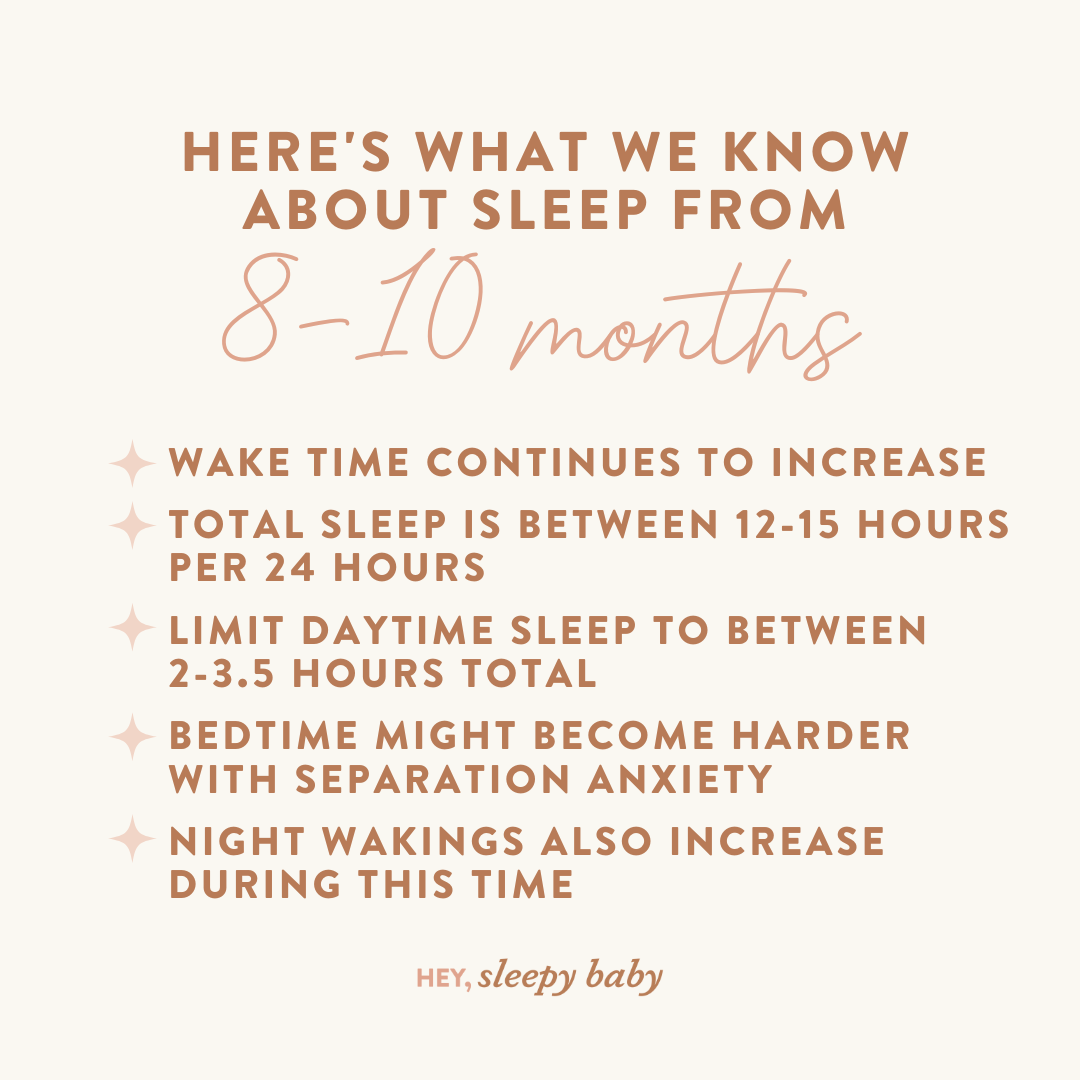
Wake time continues to increase. Most babies in this age range have wake windows between 2-4 hours and they might vary throughout the day. Most babies will drop to 2 naps around now, and may adapt well to a “2, 3, 4” wake window schedule. 2 hours between morning wake and first nap, 3 hours between naps, and 4 hours between second nap and bedtime.
-
Total sleep continues to be between 12-15 hours per 24 hours.
-
Continue to cap daytime sleep so that it does not exceed 1.5-2 hours per nap. Try to limit daytime sleep to between 2-3.5 hours total.
-
Bedtime might become harder as this age is notorious for separation anxiety. Continue to offer your presence and connection time in the evening.
-
Night wakings also increase during this time. This is mostly due to lots of physical and cognitive development happening.
What to try:
Time for another “baby bootcamp” to help baby practice those new skills! Lots of babies are crawling, pulling to stand, cruising etc. by this age and love to practice during the night. Try to give them plenty of floor time and time outside so they can get lots of exercise, sensory input, and practice on those milestones during the day.
Experiment with wake times and naps if sleep is declining. If your baby is fighting sleep, taking very short naps, taking forever to fall asleep for bedtime, etc. it could be that they are ready for a nap transition or more wake time in between naps. Most babies at this age are down to 2 naps per day. If your baby is still on 3 naps this could be why you’re struggling with getting them down. Babies need enough sleep pressure to be able to fall asleep and stay asleep.
Get outside as much as you can. This helps get your baby stimulation and sensory input so that they are ready for sleep.
Rule out any food intolerances or allergies if you’re noticing any physical symptoms (changes in poop, discomfort/ gas, vomiting, rashes, etc.) in addition to poor sleep.
Hang in there! This is a tough time for many parents and taking care of yourself and your own sleep should be job number one. Incorporating a nightly bedtime routine for yourself that includes calming elements like a cup of tea, journaling or meditation, skincare or a shower/ bath, etc. can help set yourself up for good chunks of rest in between night wakings. You also may decide to change things up with how/ who responds to your baby when they wake, if possible getting a partner involved so that you can have a solid stretch of sleep.
Some baby sleep issues are red flags worth investigating. Download my FREE advocacy guide and learn how to spot possible medical red flags, track symptoms, and talk to your child’s healthcare provider with clarity and confidence.
For more info and tips on baby sleep, visit my Instagram page!
FAQs: 8‑Month Sleep Regression — What to Know & What to Do
The so‑called 8‑month sleep regression is one of the most talked‑about disruptions in baby sleep. Here are the most common questions parents ask about it — what it is, why it happens, how long it lasts, and realistic steps you can take to help your baby (and you) rest better.
What is the 8‑month sleep regression?
The 8‑month sleep regression refers to a period around 7–9 months when a baby’s sleep pattern suddenly shifts — with more frequent night wakings, shorter naps, harder bedtimes, and clinginess. It’s tied to major developmental leaps in mobility, cognition, and sleep architecture.
Why does sleep get disrupted at around 8 months?
Many changes are happening at this age: babies are mastering sitting, rolling, crawling, and understanding object permanence. Their nervous systems and sleep cycles are also maturing. These developments can temporarily destabilize sleep because the brain is reorganizing how it processes sleep stages and wakes between them.
What are common signs of the 8‑month sleep regression?
Typical signs include increased night wakings, short naps, longer time to fall asleep, resistance at bedtime, early morning waking, fussiness around sleep, and an overall sense of “sleep falling apart” compared to prior weeks.
How long does the 8‑month sleep regression last?
Most babies move through this phase in about **2–6 weeks**, though timing varies. Some babies show only a few nights of change, while others feel it across several weeks. Consistency and patience help the transition settle sooner.
Does this regression mean something is wrong?
No. It’s a normal developmental shift — not a sign of illness or failure. Because a baby’s sleep requirements and skills are changing rapidly at this age, temporary disruption is expected. Most babies resume more predictable patterns once the developmental leap settles.
What can I do to help my baby through it?
Focus on consistent routines, watch for sleepy cues, maintain age‑appropriate wake windows, and offer comfort when needed. Extra physical closeness, predictable rituals before sleep, and calm, reassuring handling can make a big difference.
Should I change my baby’s schedule during this phase?
You might make small adjustments — earlier bedtimes, slightly shorter naps, or more consistent wake windows — based on your baby’s sleepy cues. Avoid abrupt, dramatic schedule overhauls; subtle tweaks aligned with your child’s needs tend to work best.
When should I be concerned?
If your baby’s sleep struggles are accompanied by signs of illness, poor weight gain, breathing issues, or if sleep disruption is severe and persistent beyond a few weeks, talk with your pediatrician. But isolated sleep regression behaviors by themselves are usually normal and temporary.
Was this helpful? Save it for later!

binge reads
We think you'll love these


You deserve to the
baby stage, not just "survive it."
And you DON'T have to sacrifice your values, ignore your instincts, or force yourself to follow a method you don't align with just to get your baby back to sleep.
I’m here to help you create a restful, sustainable sleep environment that honors both your baby’s needs AND your own (without the stress OR the guilt!) because, no, you don’t have to choose between the two.
enjoy!
BABY SLEEP COURSES →
BABY SLEEP CONSULTS →
Wish you could help your baby sleep better without resorting to sleep training? Download my FREE guide to a good night’s sleep and learn 8 simple, science-backed tips for supporting your child’s needs.
Traditional sleep training methods don’t have to be your solution to better sleep.


SLEEP TRAINING ISN’T THE ONLY WAY TO GET GOOD SLEEP